For most of the twentieth century, oak was sold to Europeans as the default firewood. It’s heavy, dense, and slow-burning — properties that read as virtues on a wood-merchant’s shelf. But spend a winter heating with seasoned beech in a properly designed cast iron stove, and the comparison stops being close.
The oak myth
Oak’s reputation as premium firewood is older than central heating. It was a fuel for open hearths and brick ovens — appliances where a long, slow, smouldering burn was actually useful, because the goal was thermal mass, not radiant output. A cast iron stove inverts that requirement. Its job is to deliver heat to the room, not to slowly bake a pizza oven.
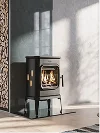
So when a customer asks us, as they often do, why their carefully purchased oak isn’t producing the heat they expected — the answer usually has more to do with the appliance than the wood. Different stoves are tuned for different burn profiles. A modern Ecodesign-compliant cast iron body, like the SAGA range, is engineered around a fast, hot, complete combustion. That favours a denser hardwood that releases its energy quickly, not slowly.
Density and calorific value
The numbers, briefly:
- Beech (European): ~720 kg/m³ at 20% moisture · 4.0 kWh/kg
- Oak (European): ~750 kg/m³ at 20% moisture · 4.2 kWh/kg
- Birch: ~680 kg/m³ at 20% moisture · 4.3 kWh/kg
- Ash: ~700 kg/m³ at 20% moisture · 4.1 kWh/kg
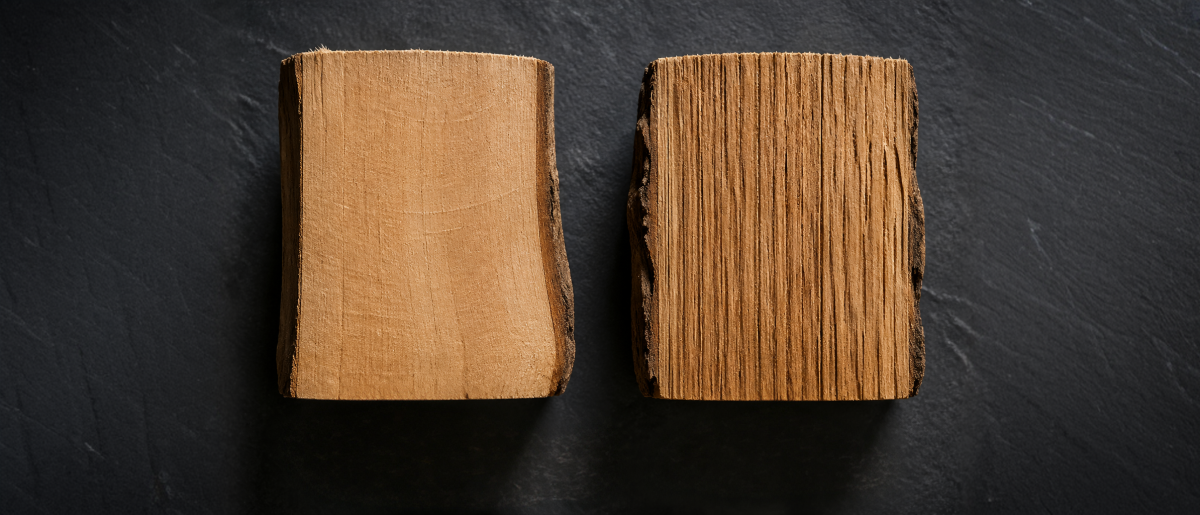
Per kilogram, the calorific values are nearly identical. The interesting difference is in release rate. Beech, with slightly more open vessel structure, releases its volatiles faster — meaning a hotter, brighter, more complete flame. Oak’s tighter cell structure makes it burn longer but cooler, which is exactly the wrong profile for a modern stove with a small, intensely-tuned firebox.
The moisture variable
Both species need to come down to 20% moisture content before they’re suitable.
But oak’s tighter structure makes it slower to season. Plan on three full summers for oak; two summers for beech. A retail wood seller’s “seasoned oak” is rarely more than a year old — which means it’s still wet enough to drop your stove’s efficiency by 30% and double its particulate output.
This is the single biggest practical reason most homes burn beech better than oak:
by the time it reaches the stove, the beech is actually dry. The oak is still cooking off water at the expense of heat output.
A wood that arrives at your stove at 28% moisture is not firewood. It’s a humidifier with a smoke problem.
A note on tannins
Oak is high in tannins. When it burns at suboptimal temperatures (which is what happens when it’s underseasoned, or when it’s burning in a stove tuned for faster wood), those tannins deposit on the inside of the chimney as sticky, acidic creosote. Over a season, this is the difference between a chimney that needs an annual sweep and one that needs an annual rebuild.
Beech contains far less tannin and burns cleaner across a wider temperature range — which is the band most home stoves actually operate in.
In practice
If you’re heating a typical European living room with a 7–10 kW cast iron stove, here is what we tell our dealers to recommend, in order of preference:
- European beech, properly air-dried two summers, split to 8–10 cm across.
- Ash, which seasons fastest of all common European hardwoods (one summer suffices) and burns nearly as cleanly as beech.
- Birch, particularly in Scandinavia where it’s locally abundant — slightly lower density but extremely clean-burning.
- Hornbeam, an underrated and often cheaper choice in central Europe.
- Oak, only if it’s been seasoned for three full summers and the price reflects that.
For installation guidance and stove-specific firewood recommendations, your certified DOVRE dealer is the right starting point. Most carry a list of regional wood suppliers they’ve vetted personally.
Three things to remember
One: the right firewood depends on the appliance. The advice that worked for your grandmother’s open hearth doesn’t apply to a 2026 Ecodesign stove.
Two: moisture content is more important than species. A correctly seasoned beech log will outperform an underseasoned oak log every time, on every metric — heat output, efficiency, emissions, chimney safety.
Three: if your stove is producing less heat than you expected, the wood is the first variable to check, not the last. Buy a £15 moisture meter and check every batch you receive. The seller’s word is not data.